
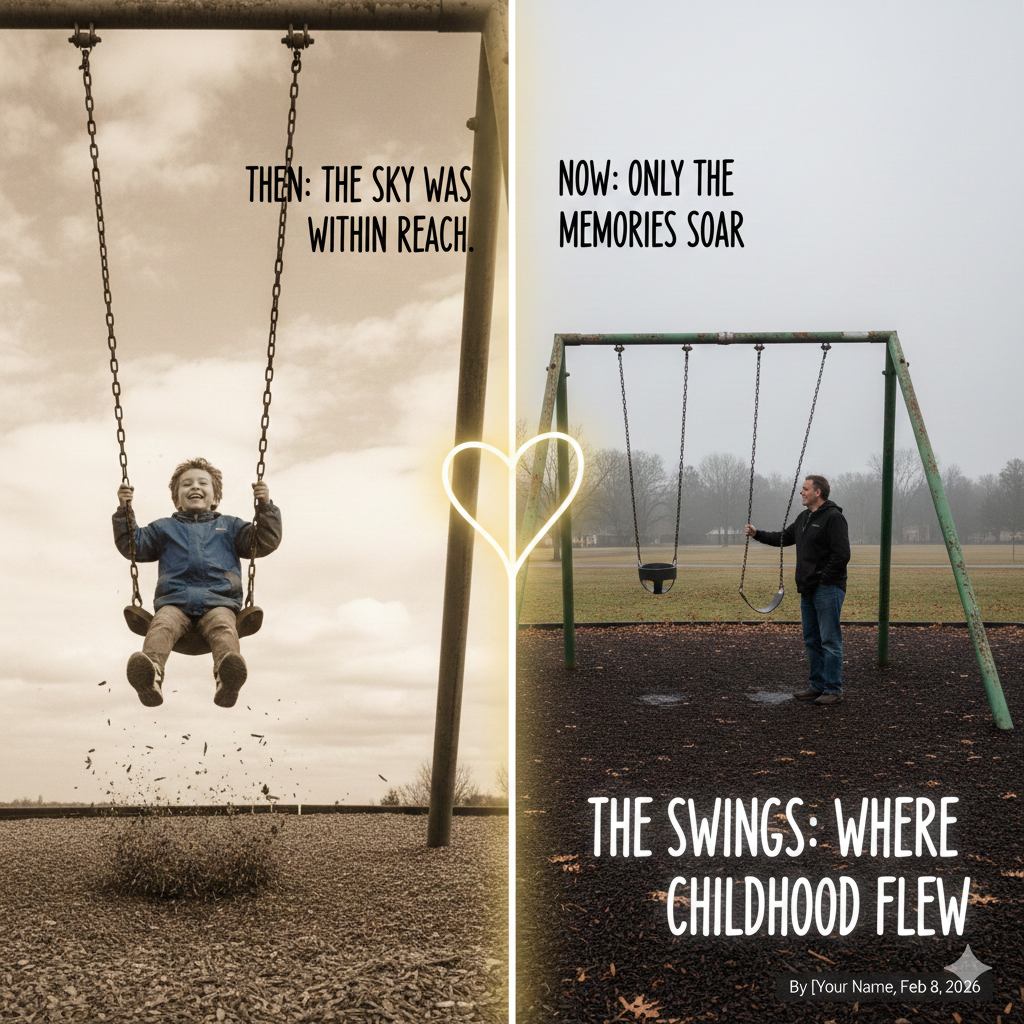
That sounds like a beautiful, nostalgic piece to write. Swings are such a universal symbol of childhood—that specific feeling of weightlessness and the rhythmic creak of the chains.
1. The Sensory Experience
To make your readers feel the memory, focus on the physical sensations:
- Touch: The cold, metallic bite of the chains on your palms; the rough texture of the rubber seat; the wind rushing past your ears.
- Sound: The rhythmic creak-clack of the bolts; the muffled thud of sneakers hitting woodchips or sand during a jump-off.
- Sight: The world blurring as you go higher; the horizon tilting; your toes pointing toward the clouds.
2. Key Themes to Explore
- The Pursuit of Flight: The childhood belief that if you just kicked hard enough, you might actually loop over the top bar or launch into the stratosphere.
- The “Jump-Off” Ritual: The brave (and slightly terrifying) moment of letting go at the highest point to see how far you could fly before hitting the ground.
- A Sanctuary for Thoughts: How the swing wasn’t just for play, but a place to process the “big” problems of being seven years old.
3. Structural Ideas
| Section | Focus |
| The Approach | Walking to the park; the anticipation; picking the “best” swing (the one that goes highest). |
| The Rhythm | The transition from standing and pushing to the steady flow of the “pump.” |
| The Apex | That split second of weightlessness at the top of the arc where time feels like it stops. |
| The Return | Coming back to the park years later and realizing how much smaller the set looks now. |
The Joy of Swinging: A Universal Experience
Swings represent more than just recreational equipment; they embody a source of joy that transcends age. The act of swinging invokes a primal happiness that is universally acknowledged, drawing children and adults alike to experience its exhilarating rhythm. For many, their first memories of being pushed on a swing serve as a nostalgic emblem of carefree childhood moments, a sentiment that resonates deeply in our collective consciousness.
The sensory experience of swinging includes the delightful feeling of weightlessness which accompanies the ascent and descent. As a swing moves higher, individuals often feel a rush of emotions—anticipation, excitement, and the intoxicating thrill of being airborne. This connection to the elements can create a sense of freedom that elicits laughter and joy, regardless of one’s age. For children, swinging is an expression of unrestrained joy, while for adults, it often rekindles long-forgotten or cherished memories from their youth.
Numerous personal stories highlight the emotional connections forged through swinging. One might recall a warm summer day spent at the park, surrounded by friends, each joyous push bringing a view of the world that felt vibrant and alive. Such shared experiences create bonds that endure, illustrating how swinging serves as a bridge across generations. Furthermore, the sound of laughter and the gentle creak of chains harmonize with the backdrop of nature, thereby enhancing the overall sensory experience.
The magnetic allure of swings extends well beyond their physical form. They are not merely metal and wood; swings symbolize nostalgia and playfulness. In a fast-paced world, the rhythmic motion of swinging allows individuals to reconnect with simple moments of joy, fostering both individual reflection and social interaction. This timeless activity remains a beloved pastime, celebrated as both a form of entertainment and a method for physical activity.
Swings as a Reflection of Childhood Innocence
Swings have long stood as an emblem of childhood innocence, reflecting a simpler time when life was defined by carefree laughter and unrestrained joy. Often found in parks and playgrounds, the rhythmic motion of swinging evokes a sense of freedom and boundless imagination. Children revel in the exhilarating sensation of flight, propelling themselves higher and higher, momentarily defying gravity, and embracing a world without limits.
This playful activity also serves as an emotional touchstone across generations, anchoring us to treasured memories of our youth. Anecdotes shared amongst adults often reveal vivid reminiscences of swings, illustrating how they acted as catalysts for joy and emotional connections. For instance, many recall societal shifts from simpler, outdoor play to more structured indoor activities, making swings a poignant symbol of the innocence that once reigned in their childhood years.
As children swing, their laughter rings clear, embodying pure joy and freedom, while simultaneously lessening the weight of the complexities of adult life. The imagery of children on swings often brings back nostalgia for many, serving as a reminder of the imagination and creativity that thrive in those carefree moments. The swaying motion not only encourages physical activity but fosters valuable social interactions, through experiences such as taking turns or playing games, enhancing relationships among peers.
The presence of swings in our lives marks moments where simplicity takes precedence, amplifying the value of childhood friendships and adventures. Whether it is the intoxicating thrill of soaring high or the calming influence of gentle rocking, swings encapsulate a world characterized by innocence and exuberance. Their enduring appeal continues to bridge the gap between generations, reminding us of the timeless joy rooted in the very act of swinging, making it not just a pastime, but a symbol of the beauty of being young.
The Therapeutic Nature of Swinging
Swinging has long been a cherished pastime, not only for children but also for adults seeking solace and comfort in its rhythmic motion. The act of swinging activates various areas of the brain, promoting a unique sensory experience that can lead to profound mental health benefits. The repetitive, soothing motion can induce a state akin to meditation, allowing individuals to escape from stress and anxiety. This therapeutic aspect of swinging facilitates relaxation by calming the mind, thereby fostering emotional resilience.
Research has demonstrated that the sensory benefits derived from swinging can enhance cognitive functions such as attention span and focus. The vestibular system, responsible for balance and spatial orientation, is engaged while swinging, which can lead to improved motor skills and coordination. These physical benefits are complemented by the emotional uplift that many experience during and after a swinging session. As the body moves, it produces endorphins, which can alleviate feelings of sadness and stress, making swinging an excellent natural remedy for enhancing mood.
Moreover, swinging offers an opportunity for mindfulness. When individuals immerse themselves in the experience of swinging, they often focus on the sensations of wind, movement, and the surrounding environment. This practice can promote a sense of presence, which is crucial in today’s fast-paced world, where distractions are prevalent. Engaging in activities that encourage such mindfulness can ultimately support emotional well-being and foster a sense of connectedness to one’s surroundings.
In summary, the therapeutic nature of swinging extends beyond mere amusement. Its meditative qualities, combined with cognitive and sensory benefits, position it as a valuable practice for enhancing mental health. Individuals seeking a simple yet effective strategy to relieve stress and promote well-being may find relief in the gentle embrace of a swing.
Swings in Culture and Symbolism
Throughout history, swings have held a significant place in various cultural contexts, serving as powerful symbols in literature, art, and popular culture. These playful structures have transcended mere recreational equipment, capturing the essence of freedom, transition, and nostalgia in a myriad of narratives. In many literary works, swings often represent pivotal moments in a character’s life, signifying the transition from childhood innocence to the complexities of adulthood. This symbolic use can be traced back to classic literature, where swings frequently feature in scenes of reflection and introspection.
In visual arts, swings have inspired countless artists who use them to convey themes of escapism and the juxtaposition of motion and stillness. For instance, in paintings and sculpture, a swing can be depicted as a solitary figure hovering between earth and sky, symbolizing the delicate balance between freedom and the weight of earthly responsibilities. Iconic artworks, such as Jean-Honoré Fragonard’s “The Swing,” encapsulate this idea beautifully, merging playful engagement with deeper emotional undertones. The swing becomes a metaphor for fleeting moments of joy and the wistfulness of time slipping away.
Moreover, swings have found their way into popular culture, appearing in films and music as emblematic representations of youthful exuberance, nostalgia, and sometimes, even melancholy. Songs that reference swings often evoke themes of longing and reminiscence, tapping into a collective memory that resonates with audiences. This recurring motif not only highlights swings’ physical presence but also their metaphorical significance in exploring themes such as freedom, connection, and the bittersweet nature of life’s transitions.


