
Screens or Scenery? Why Your Kids Need More Than Just Digits
In today’s hyper-connected world, the “digital babysitter” is an easy trap to fall into. With a swipe of a finger, kids have access to endless streams of information and entertainment. But as we navigate this 2026 digital landscape, we have to ask ourselves Are we satisfied with the results?
While screens offer data, they don’t offer development. Here is why trading the tablet for a backyard playdate might be the best investment you make for your child’s future.


The Digital Paradox: Connected but Isolated
We live in an era where information comes from every direction. Your child might know their ABCs from a YouTube video, but do they know how to negotiate, share, or read a friend’s facial expressions?
- Information vs. Interaction Digital content is passive. Real-world play is active.
- The “Vortex” Effect Screen time often leads to sedentary habits and a shorter attention span.
- Missing Cues Social nuances—the “unwritten rules” of friendship—cannot be learned from an algorithm.
The Power of the Playhouse: Building a Micro-Society
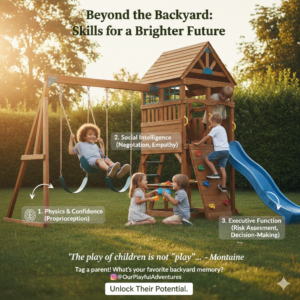
Imagine replacing that glowing screen with a Playhouse Swing Set. It’s not just wood and plastic; it’s a training ground for life. When you invite neighbors and friends over, you are creating a “mini-society” right in your backyard.
| Feature | The Development Win |
| The Slide | Teaches patience and taking turns. |
| The Playhouse | Sparks imaginative role-play (doctors, chefs, explorers). |
| The Swings | Develops motor skills and physical rhythm. |
| Group Play | Forces conflict resolution and teamwork. |
Why Start Small?
Early childhood is the “golden window” for social conditioning. By introducing kids to physical play and peer interaction early on, you help them build resilience. A scraped knee or a disagreement over who gets the red swing teaches them more about the real world than a thousand “educational” apps ever could.
The Bottom Line: We can’t hide our children from the digital world, but we can give them a solid, physical foundation so they don’t get lost in it.
Are you ready to reclaim their childhood?
The results of the digital age are mixed, but the results of a child laughing with friends on a swing set are timeless and proven. It’s time to balance the “bytes” with some “backyard” time.
Here is a practical, shareable checklist designed for parents. It highlights the essential social-emotional milestones that happen when children step away from the screen and onto the playground.
🏗️ The “Backyard Socialite” Checklist
Skills your child builds every time they play outside with others:
🤝 1. Negotiation & Conflict Resolution
Unlike a video game with set rules, outdoor play is “open-world.” Children have to decide the rules themselves.
- [ ] Can my child express what they want to play?
- [ ] Do they understand how to compromise (e.g., “I’ll go down the slide first, then you”)?
- [ ] Can they resolve a minor disagreement without immediate adult intervention?
🗣️ 2. Non-Verbal Communication
Screens mask body language. On a swing set, kids learn to read the room.
- [ ] Does my child recognize when a friend is getting tired or frustrated?
- [ ] Can they use hand gestures or facial expressions to communicate excitement?
- [ ] Are they learning to maintain appropriate personal space while playing?
🛡️ 3. Empathy & Peer Support
The physical nature of a Playhouse Swing Set creates natural opportunities for kindness.
- [ ] Does my child offer a hand to help a smaller child up the ladder?
- [ ] Do they cheer for a friend who finally musters the courage to go down the “big slide”?
- [ ] Can they wait patiently for their turn on the swing?
🎨 4. Collaborative Imagination
This is where the “Playhouse” shines. It’s never just a wooden house—it’s a spaceship, a castle, or a restaurant.
- [ ] Can my child contribute an idea to a group story?
- [ ] Do they accept the roles assigned by others (e.g., “I’ll be the chef, you be the customer”)?
- [ ] Are they able to stay focused on a group goal for more than 10 minutes?
🎢 5. Resilience & Risk Assessment
Social confidence comes from physical confidence.
- [ ] Does my child try again after a “failed” attempt at a physical challenge?
- [ ] Can they handle the “social sting” of losing a game or race gracefully?
- [ ] Are they learning to set boundaries (e.g., saying “No, that’s too high for me” or “Please don’t push me so fast”)?
💡 Pro-Tip for Parents
When you host a playdate at your home, try to be a “silent observer” for the first 15 minutes. Let them navigate the hierarchy of the playhouse on their own. The skills they learn while “figuring it out” are the exact same skills they will use in a boardroom or a team project 20 years from now.