
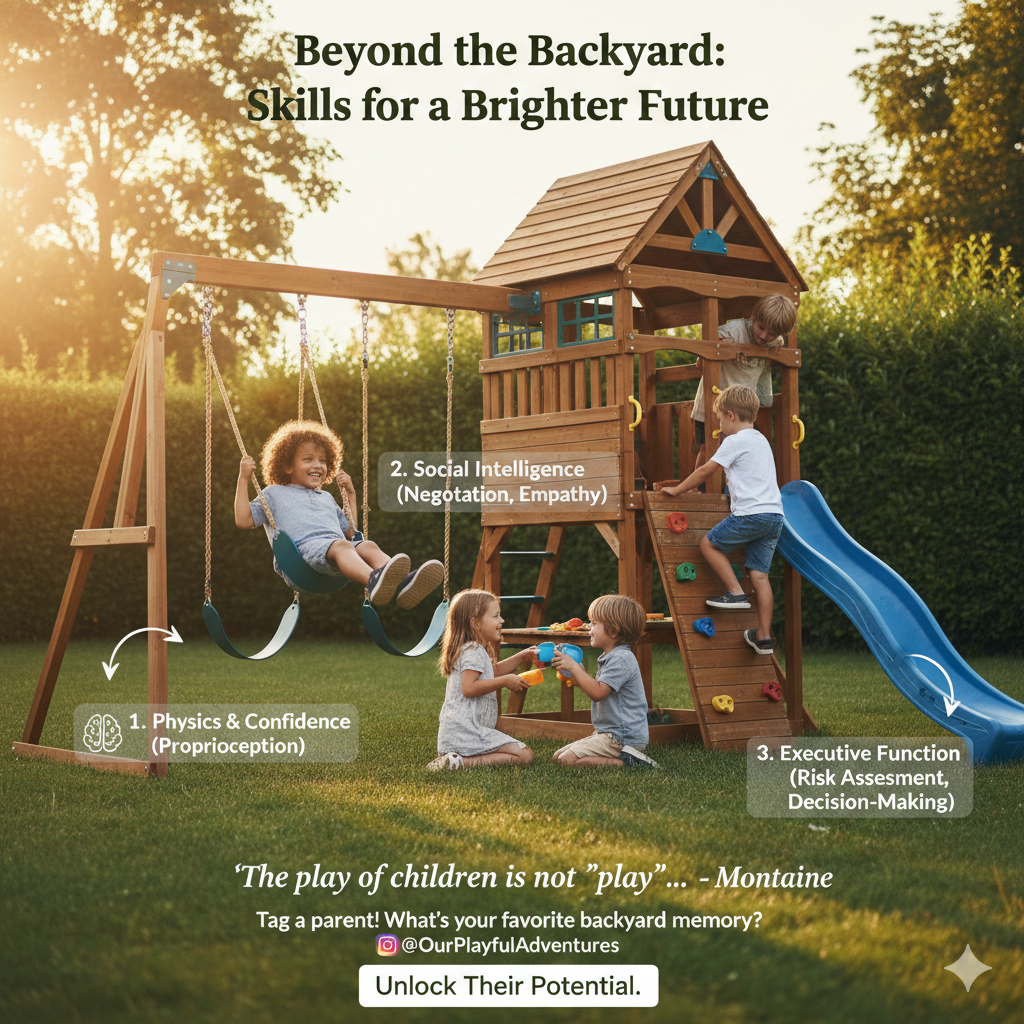
We often see a Playhouse Swing Set as a way to burn off extra energy before nap time. But if you look closer, it’s actually a sophisticated “outdoor laboratory” where your child is mastering life’s most essential skills.
From the physical rush of the slide to the quiet negotiations inside the playhouse, here is how backyard play builds better futures.
1. The Physics of High-Flying Confidence
When a child pumps their legs on a swing, they aren’t just playing; they are mastering Proprioception—the body’s ability to sense its location and movements.
- Gross Motor Skills: Climbing the rock wall or ladder builds core strength and grip power.
- The Science: Every arc of the swing teaches them about gravity and momentum in a way a classroom never could.
2. Social Intelligence in the “Secret Clubhouse”
The playhouse section is where the magic of Social-Emotional Learning (SEL) happens. This enclosed space becomes a restaurant, a space station, or a castle.
- Negotiation: “I’ll be the chef, you be the customer.” Children learn to share space, delegate roles, and resolve conflicts.
- Empathy: Role-playing helps children step into someone else’s shoes, fostering emotional maturity and communication.
3. Executive Function & Risk Assessment
Modern parenting often involves “helicoptering,” but a swing set provides a safe environment for Managed Risk.
- Decision Making: “Can I jump from this height?” “How fast can I go?”
- Confidence: Overcoming the fear of the “big slide” creates a dopamine hit of achievement that translates to better self-esteem in school and sports.


“The play of children is not ‘play’ in the usual sense… it is their most serious business.” — Montaigne
Why Our Designs Matter
We don’t just build sets; we curate environments for growth. Our playhouses feature:
- Multi-level platforms to encourage spatial awareness.
- Tactile textures to stimulate sensory development.
- Open-ended layouts that leave room for a child’s imagination to fill in the blanks.
The Importance of Play in Child Development
Play is an essential aspect of childhood that serves as the foundation for children’s overall growth and development. Engaging in play allows children to explore their environment, express creativity, and develop crucial skills that will benefit them throughout their lives. Various forms of play contribute uniquely to child development, including physical, imaginative, and social play.
Physical play, which includes activities such as climbing, swinging, and running, plays a vital role in enhancing motor coordination, strength, and overall health. As children navigate their play environment, they refine their gross and fine motor skills, improving their balance and coordination. For instance, children who frequently use a playhouse swing set engage in physical play that strengthens muscles and enhances coordination, setting the groundwork for a healthy lifestyle.
Imaginative play, on the other hand, encourages creativity and cognitive growth. When children engage in role-playing or storytelling, they not only develop their imagination but also enhance their problem-solving capabilities and emotional intelligence. This type of play allows them to experiment with different scenarios, enabling them to understand the world around them more fully and learn empathy through character interactions.
Social play encompasses interactions with peers and siblings, where children learn to collaborate, negotiate, and develop communication skills. By participating in group games or activities, children gain valuable experience in conflict resolution and understanding social dynamics. For example, when children play together on a swing set, they practice taking turns and cooperating, which fosters a sense of teamwork and mutual respect.
Incorporating a playhouse swing set into children’s playtime can significantly enhance these developmental experiences. By providing a safe, versatile outdoor environment for various types of play, swing sets promote physical activity, boost imaginative engagement, and facilitate social interactions. Understanding the importance of play is crucial for fostering holistic child development.
Physical Benefits Building Strength and Coordination
Engaging with a playhouse swing set provides numerous physical benefits that are essential for a child’s development. Activities such as swinging, climbing, and sliding are not merely fun; they play a vital role in enhancing muscle strength. For instance, swinging helps build upper body strength as children grasp the swing’s handles and pull themselves back and forth. Additionally, climbing on various structures within the playhouse develops strength in the arms, legs, and core, essential muscles that support overall physical activities.
Moreover, these activities contribute significantly to improving balance and coordination. As children navigate the swinging motions or attempt to maintain their balance while sliding, they are actively working on their proprioception—their awareness of body position and movement in space. This enhanced coordination can translate to improved physical performance in various sports and recreational activities, facilitating a more active lifestyle as they grow.
The implications of such active play extend beyond immediate physical abilities, playing a crucial role in preventing issues related to health, such as obesity. Regular use of a playhouse swing set promotes cardiovascular health through continuous movement. This activity not only burns calories but also instills healthy habits, encouraging children to appreciate physical activity from a young age.
Furthermore, by fostering an environment where children can engage in structured and unstructured physical play, caregivers support the development of lifelong fitness habits. Active play through a playhouse swing set builds a foundation for healthy living, teaching children the joy of movement while simultaneously contributing to their physical development.
Cognitive Development Encouraging Creativity and Problem-Solving
A playhouse swing set serves not only as a source of physical entertainment but also as a catalyst for cognitive development in children. The versatility of such play structures encourages imaginative play, allowing children to step into various roles and scenarios. This form of unstructured playtime is crucial for nurturing creativity, as children invent stories and characters, transforming a simple swing set into a pirate ship or a castle, for instance.
Engaging in imaginative play promotes critical thinking by enabling children to devise solutions to the situations they create. When constructing an imaginary adventure, they may encounter problems that require out-of-the-box thinking, such as how to rescue a toy from the “dragon’s den” atop the swing set. This type of role-play challenges them to think critically about their environment, evaluate their options, and make decisions, thus fostering essential problem-solving skills.
Furthermore, these playhouse structures often include accessories and features that can stimulate creativity. For example, swings that resemble rocket ships or slides that serve as secret entrances enhance the play experience. By altering their use of the swing set, children learn to adapt and explore different functions, further encouraging imaginative play. Activities that involve group play, such as organizing games or reliving scenarios, also bolster social skills, as children learn to negotiate roles, share ideas, and collaborate for a common goal.
The cognitive benefits derived from a playhouse swing set extend beyond mere entertainment; they provide essential opportunities for children to engage in cognitive exercises that promote creativity and problem-solving. These activities help develop a child’s mental agility, prepare them for academic challenges, and ultimately support their overall growth and development.
Social Skills and Emotional Benefits Navigating Relationships Through Play
Play is an essential component of childhood that fosters not just physical development but also social and emotional growth. A playhouse swing set serves as a dynamic environment where children engage in various social interactions, which are crucial for developing effective communication skills and forming friendships. When children play together on a swing set, they are not only having fun but also learning to cooperate, negotiate, and resolve conflicts, aspects that are vital for healthy interpersonal relationships.
Cooperative play, a fundamental aspect of shadowing relationships, is often inherent in activities involving playhouse swing sets. As children take turns on swings or share the space, they begin to understand the importance of listening and respecting one another’s feelings and needs. Through these interactions, they develop negotiation skills, as they must often discuss who goes next or how to take turns—lessons that translate to everyday situations both in and out of a school setting.
Moreover, the emotional benefits of engaging in collective play cannot be overstated. Facing challenges, such as pushing a friend on a swing or trying to climb to the top of a playhouse together, builds resilience and boosts self-confidence. These experiences create a sense of community and belonging among children, as they support each other, celebrate achievements, and navigate failures. The shared triumphs and setbacks during play cultivate emotional intelligence, equipping children with the tools to manage their feelings and empathize with others in varying situations.
In essence, a playhouse swing set acts as more than just a recreational facility; it is a microcosm of social interactions that enrich child development. By promoting cooperative play and fostering emotional resilience, playhouse swing sets contribute significantly to the social and emotional well-being of children, preparing them for a lifetime of healthy relationships.